
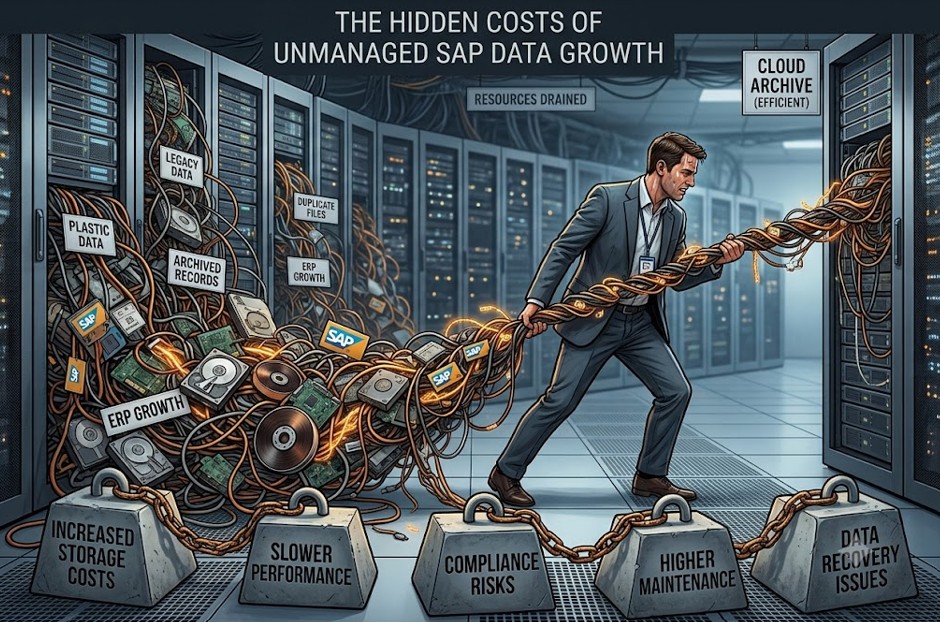
Summary: Unmanaged data growth in SAP systems creates a cascade of hidden expenses far beyond storage fees. From inflated HANA memory costs and degraded system performance to extended migration timelines and compliance risks, the financial impact is significant and often underestimated. Proactive data volume management is the key to reversing these trends. Dive into the article for more.
Introduction
Every SAP system generates data continuously. Transactions are processed, documents are created, logs are written, and records accumulate across modules day after day. In well-managed environments, this growth is anticipated and controlled. In many organisations, however, data volumes expand unchecked, creating a range of costs that extend far beyond what appears on a storage invoice.
SAP data growth costs are often hidden within broader IT budgets, making them difficult to identify and attribute. Yet the cumulative financial impact is substantial. This article examines where these hidden costs arise and how organisations can address them through proactive data volume management.
The direct cost: HANA memory
The most visible impact of unmanaged data growth in SAP S/4HANA environments is the cost of HANA memory. Unlike traditional disk-based databases, HANA stores data in memory, which means every additional gigabyte directly increases memory consumption and, consequently, licensing and infrastructure expenses.
A practical guideline illustrates the scale: approximately 2TB of HANA memory is required for every 1TB of active data. When data volumes grow unchecked, organisations face expensive memory upgrades or, worse, run out of available memory entirely, triggering complex and disruptive expansion projects. HANA memory costs are not linear; they escalate as organisations move to larger server configurations, making unmanaged growth disproportionately expensive. For many organisations, this represents the single largest component of SAP infrastructure costs.
Performance degradation: the invisible tax
Beyond direct costs, unmanaged data growth imposes a performance tax on every user and process in the system. Larger databases mean slower queries, longer batch processing times, and extended reporting cycles. Month-end financial closes, material requirements planning runs, and routine data extractions all take longer as data volumes increase.
This degradation is often gradual, making it difficult to notice until it reaches critical levels. A report that once completed in seconds may eventually take minutes; a batch job that ran overnight may begin extending into business hours. These delays reduce productivity, frustrate users, and can affect the timeliness of business decisions. The cost is real, even if it does not appear as a line item in the IT budget, and it compounds existing SAP data growth costs across the organisation.
Migration and transformation: paying twice for neglect
Organisations planning S/4HANA migrations feel the impact of unmanaged data volumes most acutely. Larger data volumes directly increase migration complexity, extend project timelines, and inflate project budgets. Research consistently shows that SAP migration projects take approximately 30 per cent longer than planned, and over 60 per cent exceed their budget, often due to underestimated data volumes.
The average SAP ECC system holds 15 to 20 years of transactional history, much of which does not need to migrate to S/4HANA. Yet without data volume management, all of this data is carried forward, increasing the migration footprint unnecessarily. Pre-migration archiving can identify an average of 23 per cent cost reduction opportunities, but this benefit is only available to organisations that address data volumes proactively before the project begins.
Backup, recovery, and system availability
Larger databases require longer backup windows and extended recovery times. In an era where system availability is a business-critical requirement, these delays carry real risk. If a system failure occurs, the time required to restore a bloated database could mean hours of additional downtime compared to a properly managed environment.
SAP infrastructure costs associated with backup storage also increase proportionally with data volume. Organisations maintaining redundant backups across multiple locations face multiplied expenses for data that, in many cases, could have been archived to lower-cost storage tiers long ago.
Compliance risks
Unmanaged data growth creates compliance challenges as well. When vast quantities of data remain in production systems without clear retention policies, organisations struggle to respond to data subject access requests, audit enquiries, and regulatory investigations efficiently. The inability to locate and produce specific records promptly can result in regulatory penalties and reputational damage.
Furthermore, retaining data beyond its required retention period, particularly personal data, can itself constitute a compliance violation under regulations such as GDPR. Effective data volume management ensures that data is retained for the appropriate period and archived or disposed of in accordance with legal requirements, reducing both risk and HANA memory costs.
The solution: proactive data volume management
The encouraging reality is that SAP data growth costs are largely avoidable. Organisations that implement proactive data volume management strategies can reduce active database volumes by up to 60 per cent and cut storage-related expenses by 40 to 50 per cent.
A data volume assessment provides the starting point, analysing database composition, growth trends, high-volume tables, and archiving opportunities. From there, organisations can implement targeted archiving of high-impact data objects, establish automated processes to maintain ongoing control, and align retention policies with regulatory requirements.
The result is a leaner, faster, and more cost-effective SAP environment that supports, rather than hinders, business operations and transformation programmes. Addressing SAP infrastructure costs through data volume management is one of the highest-return investments an IT organisation can make.
Conclusion
The hidden costs of unmanaged SAP data growth are real, significant, and cumulative. From escalating HANA memory costs and degraded performance to inflated migration budgets and compliance risks, neglecting data volumes is an expensive proposition. Organisations that invest in proactive data volume management not only reduce their SAP data growth costs but also position themselves for more efficient operations, faster transformations, and stronger regulatory compliance.
TJC Group starts its SAP data archiving engagements with a data volume assessment, then puts the archiving plan into practice so that the savings hold long after the first project ends.
Frequently asked questions
How quickly do SAP data volumes typically grow?
Growth rates vary by organisation, but enterprise SAP systems commonly see data volumes increase by 20 to 40 per cent annually. Without proactive management, this growth compounds rapidly, amplifying costs and performance impacts over time.
What is the most cost-effective way to address SAP data growth?
Data archiving is typically the most cost-effective approach. By moving inactive data to lower-cost storage whilst preserving accessibility, organisations can reduce HANA memory costs significantly without losing access to historical records.
Can data volume management improve S/4HANA migration outcomes?
Yes. Reducing data volumes before migration shortens project timelines by 30 to 70 per cent, lowers costs, and improves data quality in the target system. Pre-migration archiving is widely recognised as a best practice for controlling SAP infrastructure costs.
How does unmanaged data growth affect compliance?
Excessive data retention makes it difficult to respond promptly to audit requests, data subject access requests, and regulatory enquiries. It can also lead to violations of data protection regulations that require data to be disposed of once its purpose has been fulfilled.

Purnima is a content writing expert with experience creating engaging articles, blog posts, Wikipedia content, and books. Passionate about storytelling and research, Purnima enjoys exploring diverse subjects and turning complex topics into clear, informative content.
Beyond writing, she is passionate about travel and singing and has a strong curiosity about emerging technologies and evolving digital trends, particularly Artificial Intelligence (AI), generative search, and the Internet of Things (IoT). She also enjoys exploring current affairs and politics, constantly looking to learn, research, and dive deeper into new ideas.