
Imagine managing thousands—or even millions—of connected devices spread across different cities or countries. Whether you’re tracking delivery trucks, monitoring factory equipment, or managing smart home devices, handling all that data manually isn’t practical.
What is AWS IoT?
That’s where Amazon Web Services (AWS) IoT comes in.
AWS IoT is a cloud platform that helps businesses securely connect their devices, collect real-time data, automate processes, and gain valuable insights—all without worrying about building or maintaining complex infrastructure.
From startups developing innovative IoT products to global manufacturers operating thousands of industrial sensors, AWS IoT has become one of the most trusted platforms for building connected solutions.
In this guide, we’ll explain everything you need to know about AWS IoT, including its key features, pricing, architecture, advantages, limitations, and whether it’s the right platform for your business.
Quick Overview about AWS IoT – AWS IoT at a Glance
| Feature | Details |
|---|---|
| Platform | Amazon Web Services (AWS) IoT |
| Best For | Enterprise, Industrial IoT, Smart Manufacturing |
| Deployment | Cloud + Edge Computing |
| Device Protocols | MQTT, HTTP, WebSockets |
| Security | TLS, X.509 Certificates, IAM |
| Pricing | Pay-as-you-go |
| Free Tier | Available for eligible new AWS accounts |
| Ideal For | Manufacturing, Retail, Healthcare, Logistics |
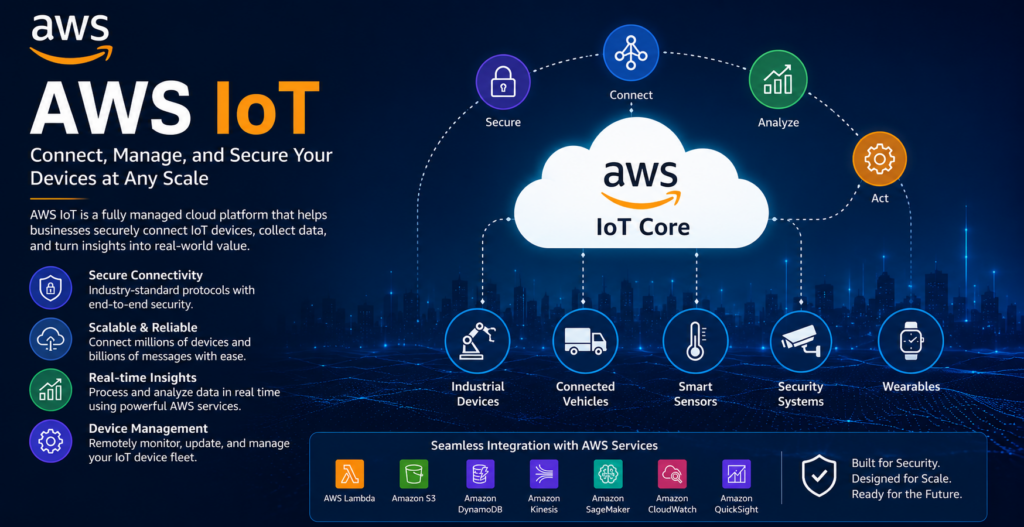
Think of AWS IoT Core as the communication hub for all your smart devices. Whether it’s a temperature sensor in a warehouse or a GPS tracker inside a delivery vehicle, AWS IoT Core securely receives information from every connected device and routes it to the right AWS services for processing.
Businesses choose AWS IoT because it removes much of the complexity involved in building connected applications. Instead of managing servers, databases, and security separately, AWS provides everything under one ecosystem.
Some of its biggest strengths include:
- Secure communication between millions of devices
- Real-time data processing
- AI and machine learning integration
- Remote device management
- Edge computing with AWS Greengrass
- Enterprise-grade security
- Automatic scaling as your business grows
AWS IoT Architecture
A typical AWS IoT architecture consists of:
- IoT Devices
- MQTT/HTTP Communication
- AWS IoT Core
- Rules Engine
- AWS Lambda
- Amazon S3
- DynamoDB
- Amazon Kinesis
- Amazon SageMaker
- CloudWatch
This architecture enables businesses to process millions of messages with minimal infrastructure management.
Key Features of AWS IoT
1. Secure Device Connectivity
- MQTT
- HTTP
- WebSockets
- TLS encryption
- X.509 certificates
2. Device Management
AWS enables businesses to:
- Register devices
- Organize device groups
- Update firmware remotely
- Monitor fleet health
3. Rules Engine
Automatically send incoming IoT data to:
- Lambda
- S3
- DynamoDB
- SNS
- SQS
- Kinesis
- Redshift
without writing complex integration code.
4. Device Shadow
A Device Shadow stores the last known state of a device, allowing applications to read and update state even when the physical device is offline.
5. Edge Computing
Using AWS IoT Greengrass, businesses can:
- Run ML models locally
- Process data offline
- Reduce latency
- Save bandwidth
6. AI & Machine Learning
AWS integrates with:
- Amazon SageMaker
- Bedrock
- Rekognition
- Forecast
- Lookout for Equipment
7. High Scalability
AWS IoT Core supports billions of connected devices and trillions of messages without customers managing server infrastructure.
Industries Using AWS IoT
- Manufacturing
- Automotive
- Agriculture
- Healthcare
- Retail
- Logistics
- Energy
- Smart Cities
- Smart Buildings
AWS IoT Use Cases
- Predictive Maintenance
- Fleet Tracking
- Smart Metering
- Industrial Automation
- Asset Monitoring
- Cold Chain Monitoring
- Connected Vehicles
- Smart Agriculture
- Healthcare Monitoring
Benefits of AWS IoT
Fully Managed Platform
- Global Infrastructure
- High Security
- Auto Scaling
- Pay-as-you-go Pricing
- AI Integration
- Easy AWS Integration
- Edge Computing Support
AWS IoT Security Features
AWS provides:
- Device Authentication
- TLS Encryption
- IAM Integration
- Device Certificates
- Role-Based Access
- Audit Logs
- Device Defender
- Secure Fleet Provisioning
AWS IoT Pricing
AWS IoT Core follows a pay-only-for-what-you-use pricing model. Charges are based on components such as connectivity time, messages, Device Shadow operations, registry operations, and Rules Engine usage. There are no mandatory minimum service fees. Pricing varies by AWS Region.
| Component | Pricing Model* |
|---|---|
| Connectivity | Charged per million connection minutes |
| Messaging | Charged per million messages |
| Device Shadow | Charged per million operations |
| Registry Operations | Charged per million operations |
| Rules Engine | Charged per million rules triggered/actions |
| Device Location | Usage-based pricing |
| Greengrass | Charged per active core device/month |
*Actual pricing varies by AWS Region. Refer to the official AWS Pricing page for the latest rates.
AWS Free Tier
New AWS accounts receive a free usage tier for AWS IoT Core, including monthly allowances for connection minutes, messages, Device Shadow/Registry operations, and Rules Engine executions for the introductory period. AWS also offers promotional Free Tier credits for eligible new customers.
AWS IoT Pros
✔ Highly scalable
✔ Enterprise-grade security
✔ Easy AWS integration
✔ Managed infrastructure
✔ AI-ready
✔ Global availability
✔ Excellent documentation
AWS IoT Cons
- Pricing can become complex for very large fleets.
- Deep AWS knowledge may be required for advanced implementations.
- Managing multiple AWS services can increase operational complexity.
AWS IoT vs Traditional IoT Platforms
| Feature | AWS IoT | Traditional Platform |
|---|---|---|
| Scalability | Excellent | Moderate |
| Security | Enterprise-grade | Varies |
| AI Integration | Native | Limited |
| Global Infrastructure | Yes | Limited |
| Edge Computing | Yes | Limited |
| Pay-as-you-go | Yes | Depends |
Who Should Use AWS IoT?
AWS IoT is ideal for:
- Startups
- Enterprises
- Manufacturers
- Automotive companies
- Smart city projects
- Healthcare providers
- Logistics companies
- Energy providers
Getting Started
- Create an AWS Account.
- Open AWS IoT Core.
- Register your device.
- Create certificates.
- Connect using MQTT.
- Configure Rules Engine.
- Store data in AWS services.
- Build dashboards using QuickSight or CloudWatch.
Contact AWS
Official Website: Amazon Web Services (AWS)
AWS IoT Product Page: AWS IoT
Pricing: AWS IoT Core Pricing
Documentation: AWS IoT Documentation
Sales Contact: Contact AWS Sales
Frequently Asked Questions
Ques: Is AWS IoT free?
Ans: AWS IoT Core offers a Free Tier for eligible new AWS customers, after which charges are based on actual usage.
Ques: Does AWS IoT support MQTT?
Ans: Yes. AWS IoT Core supports MQTT, HTTP, and WebSockets for device communication.
Ques: Can AWS IoT process millions of devices?
Ans: Yes. AWS IoT Core is designed to securely connect and manage very large fleets of IoT devices.
Ques: Is AWS IoT secure?
Ans: Yes. It includes X.509 certificates, TLS encryption, IAM integration, and device-level security controls.
Real-World Examples
Example 1: Manufacturing
A manufacturing company installs sensors on production machines.
Whenever a machine starts overheating, AWS IoT automatically sends an alert to the maintenance team, reducing downtime and preventing expensive equipment failures.
Example 2: Logistics
A logistics company tracks hundreds of delivery vehicles using GPS devices connected to AWS IoT.
Fleet managers can monitor locations in real time, optimize routes, and improve delivery efficiency.
Example 3: Healthcare
Hospitals use connected medical devices to monitor patients remotely.
AWS IoT securely collects patient data and helps healthcare providers respond quickly when abnormalities are detected.
Conclusion
As businesses become increasingly connected, choosing the right IoT platform is more important than ever. AWS IoT stands out because it combines secure device connectivity, powerful cloud services, AI capabilities, and global scalability in a single ecosystem.
Whether you’re building a smart factory, launching a connected healthcare solution, or tracking assets across the globe, AWS IoT provides the flexibility to start small and scale as your needs grow. For organizations already invested in AWS, it offers a natural path to developing secure and intelligent IoT applications.

Purnima is a content writing expert with experience creating engaging articles, blog posts, Wikipedia content, and books. Passionate about storytelling and research, Purnima enjoys exploring diverse subjects and turning complex topics into clear, informative content.
Beyond writing, she is passionate about travel and singing and has a strong curiosity about emerging technologies and evolving digital trends, particularly Artificial Intelligence (AI), generative search, and the Internet of Things (IoT). She also enjoys exploring current affairs and politics, constantly looking to learn, research, and dive deeper into new ideas.